
A landing page and a full website are not competing products they are two different tools built for two different jobs. A landing page is a single-purpose lead-capture machine designed for one campaign, one offer, one action. A full website is your complete business presence, built to inform, rank on Google, and serve every type of visitor at every stage of their decision. Choosing wrong or choosing one when you need both is the single most common reason Indian businesses waste ad spend and lose enquiries.
This guide breaks down exactly when a landing page wins, when a full website wins, what real businesses have seen in conversion data, and why the smartest answer for most growing businesses in 2026 is not “either/or” but a structured combination of both built to work together.
You just spent ₹15,000 on Google Ads this month. The clicks came in. The enquiries did not. Somewhere between the ad click and the contact form, your potential customer disappeared, and the page they landed on is very likely the reason why.
This is the exact problem this article solves. Landing page vs full website is not a theoretical debate it is a decision that directly affects how many leads convert from every rupee you spend on marketing.
By the end of this article, you will know exactly which one to use for your next campaign, which one to use for your long-term brand presence, and how MaaJanki Web Tech structures both for clients who want maximum leads without wasted ad spend.
Landing Page vs Full Website: The Quick Answer
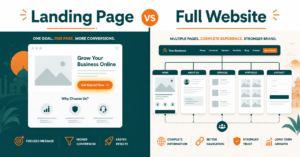
A landing page is a single, focused page built around one offer with one call-to-action designed to convert visitors from a specific ad or campaign. A full website is a multi-page presence (home, services, about, blog, contact) built for long-term branding, SEO, and serving every type of visitor. For paid ad campaigns and specific offers, landing pages convert 2–3x higher. For organic search traffic and brand trust, a full website wins. Most growing businesses need both, not one instead of the other.
What Is a Landing Page? (And What It Is Not)
A landing page is a standalone web page with exactly one goal: to convert the visitor into a lead or sale. No navigation menu. No distractions. No other pages to click into.
A real landing page includes:
- One headline that states the offer or benefit clearly
- One supporting section that builds trust (testimonials, numbers, guarantees)
- One call-to-action repeated 2–3 times down the page
- A lead capture form or WhatsApp click-to-chat button
- Zero navigation links are pulling the visitor away
What a landing page is NOT:
- It is not your homepage
- It is not meant to explain everything about your business
- It is not built for SEO ranking on broad keywords
- It is not a replacement for a full website
Honest example: A Pune-based interior design studio running a Diwali offer campaign built a single landing page: “Get Your Living Room Redesigned Before Diwali Free Consultation.” No menu. No “About Us” link. Just the offer, three before-and-after photos, a testimonial, and a WhatsApp button. That page converted at 9.2% from paid traffic, nearly triple what their full website homepage converted at for the same ad spend.
What Is a Full Website? (And Why It Still Matters in 2026)
A full website is your complete digital business presence, multiple pages working together to inform, build trust, and convert visitors who are at different stages of deciding whether to work with you.
A full website typically includes:
- Homepage
- About / Our Story page
- Services or Products pages
- Portfolio or Case Studies
- Blog (critical for long-term SEO)
- Contact page with multiple contact methods
- Testimonials or reviews page
Why a full website cannot be replaced by a landing page:
- Google ranks websites with depth and topical authority, not single pages
- Visitors researching your business (not from an ad) expect to explore freely
- A blog drives long-term organic traffic that a landing page cannot generate
- B2B buyers specifically look for an “About” page and case studies before trusting a vendor
Honest example: A Surat-based B2B packaging manufacturer relied only on a single-page website for two years. They ranked nowhere on Google for “packaging manufacturer Surat” because Google had no content depth to evaluate. After building a full website with 12 pages and a blog, they began ranking on page 1 within five months, something a landing page alone could never achieve.
📖 Read Also: Not sure whether to build a custom site or use a no-code builder for either option? This breaks down the real trade-offs: Web Development vs. Website Builders: Which One Should You Choose?

Landing Page vs Full Website: Side-by-Side Comparison
| Factor | Landing Page | Full Website |
|---|---|---|
| Primary Goal | Convert one specific offer | Inform, build trust, rank on Google |
| Number of Pages | 1 | 5–50+ |
| Navigation Menu | None (intentionally) | Full menu and footer links |
| Best Traffic Source | Paid ads, social campaigns, email | Organic search, referrals, direct visits |
| SEO Value | Very low not built to rank broadly | High core SEO and authority asset |
| Conversion Rate (Typical) | 5–15% from targeted traffic | 1–3% from general traffic |
| Build Time | 3–7 days | 2–8 weeks |
| Cost Range (India) | ₹8,000 – ₹35,000 | ₹45,000 – ₹2,50,000+ |
| Lifespan / Reusability | Short built per campaign | Long-term core business asset |
| Best Use Case | Specific offer, product launch, event | Brand presence, long-term lead generation |
When a Landing Page Wins: Real Scenarios
Scenario 1: Running Google Ads or Meta Ads. If you send paid traffic to your full website homepage, you are paying for clicks and losing most of them to a distracted visitor exploring five other pages. A dedicated landing page matching the exact ad promise converts dramatically higher because it removes every distraction.
Scenario 2: Launching a Specific Offer or Product: A new course, a seasonal discount, a webinar registration, a free consultation, all of these deserve their own focused page. Burying a time-sensitive offer inside a full website’s “Services” page guarantees lower visibility and lower urgency.
Scenario 3: Testing a New Market or Service Before Full Investment Before building an entire website section for a new service line, a landing page lets you test demand with real ad spend and real conversion data at a fraction of the cost and time.
Scenario 4: Event Registration or Webinar Signups Single-purpose events need single-purpose pages. Date, time, speaker, registration form, nothing else competing for attention.
Ready to Build a Website (or Landing Page) That Actually Converts?
Send us your business goal on WhatsApp, whether it is a single campaign landing page or a full business website — and get a free 10-minute consultation on the right structure for your situation.
📱 WhatsApp: MaaJanki Web Tech — Chat Now
📧 Email: info@maajankiwebtech.com
🌐 Website: maajankiwebtech.com | mjbytech.com
When a Full Website Wins: Real Scenarios
Scenario 1: You want to rank on Google Organically Google’s algorithm rewards topical depth, internal linking, and consistent content, none of which a single landing page can provide. If long-term organic traffic is your goal, a full website with a blog is non-negotiable.
Scenario 2: B2B Buyers Are Researching You B2B decision-makers in India routinely check a vendor’s About page, team page, and case studies before reaching out. A landing page alone signals “this might not be a real, established company”, a credibility risk you cannot afford in B2B sales.
Scenario 3: You Offer Multiple Services or Products A hospital, school, or multi-service agency cannot compress everything into one page. Different visitors need different information a full website’s structure exists precisely to serve this variety.
Scenario 4: Building Long-Term Brand Equity A full website becomes more valuable over time, with more blog posts, more backlinks, and more domain authority. A landing page resets to zero relevance the moment its campaign ends.
📖 Read Also: Once you have decided on your structure, here is how to start turning visitors into your first paying customers: How to Get Your First 100 Customers Online
The Conversion Data: What Actually Happens in Real Campaigns
From running paid and organic campaigns for 200+ Indian businesses, the pattern at MaaJanki Web Tech is consistent and worth stating plainly:
Paid ad traffic → Landing page: Average conversion rate 6–12% Paid ad traffic → Full website homepage: Average conversion rate 1.5–4% Organic search traffic → Full website with blog: Average conversion rate 2–5% Organic search traffic → Standalone landing page: Rarely ranks, minimal organic traffic exists to convert
The number that should matter most to you: sending paid traffic to a homepage instead of a matching landing page typically cuts your conversion rate by 50–70%. If you are running ads right now and pointing them at your homepage, that single decision is likely costing you more in wasted ad spend than the cost of building a proper landing page.
This does not mean landing pages are “better”, it means each tool wins on its own terrain. A landing page sent organic search traffic with no other content behind it will simply never get found in the first place.
📖 Read Also: Trying to decide where your next marketing rupee should go SEO or paid traffic? This comparison settles it: SEO vs. Paid Ads: Which One Is Right for Your Business?
How to Decide: A Simple Framework
Ask yourself these four questions in order:
1. Where is my traffic coming from? Paid ads or a specific campaign link → Landing page, Google search, or general brand awareness → Full website
2. Am I promoting one specific thing or my whole business? One offer, one product, one event → Landing page Everything I do, my full range of services → Full website
3. Do I need this to rank on Google long-term? No, this is a short-term campaign → Landing page Yes, I want sustainable organic traffic → Full website
4. Will buyers need to research and trust me before contacting me? No, the offer itself is the trust-builder → Landing page Yes, they will check my credibility first → Full website
If you answered “landing page” to most questions, build a landing page for this specific campaign, but do not let it replace your need for a proper full website in parallel.
The Smartest Strategy in 2026: Use Both, Structured Correctly
Here is the real insight most agencies will not tell you because it requires more work, not less: the highest-performing Indian businesses do not choose between a landing page and a full website. They run both, connected strategically.
The structure that works:
- Full website as your permanent digital home, SEO foundation, brand trust, all services explained, blog for organic growth
- Multiple landing pages built off the same website for specific campaigns, each one linking back to the main site for visitors who want to explore further
- Consistent branding across both so visitors recognise they are dealing with the same trusted business
- Landing pages refreshed per campaign, while the full website remains a stable, evergreen asset
Example structure for a typical MaaJanki Web Tech client:
- maajankiwebtech.com — full website (services, blog, about, portfolio)
- maajankiwebtech.com/diwali-website-offer — campaign landing page
- maajankiwebtech.com/free-seo-audit — lead magnet landing page
This is not duplicate work, it is smart infrastructure. The full website does the long-term job. The landing pages do the short-term, high-intent conversion job. Together, they cover every visitor at every stage.
What Should You Include on a High-Converting Landing Page?
If you decide a landing page is right for your next campaign, here is the non-negotiable checklist:
Above the fold:
- [ ] Clear headline stating the exact benefit (not a vague tagline)
- [ ] Supporting subheadline with a specific detail (number, timeframe, guarantee)
- [ ] Primary call-to-action button visible without scrolling
Trust elements:
- [ ] At least one testimonial with a real name and result
- [ ] Trust badges, certifications, or client logos if available
- [ ] A specific number or statistic (“Helped 200+ businesses…”)
Conversion elements:
- [ ] Lead capture form with minimal fields (name, phone, one qualifying question)
- [ ] WhatsApp click-to-chat button extremely high response rate in the Indian market
- [ ] Call-to-action repeated at least 2–3 times down the page
Technical basics:
- [ ] Page loads in under 2.5 seconds (paid traffic abandons slow pages instantly)
- [ ] Mobile-first design, most Indian ad traffic arrives on mobile
- [ ] Zero navigation menu, no exit points except the conversion action
What Should Your Full Website Include to Actually Generate Leads?
A full website that just exists is not the same as a full website that converts. Here is what separates the two:
- Homepage with a clear value proposition in the first 5 seconds of viewing
- Service pages with specific outcomes, not vague descriptions — “We helped a Ludhiana retailer grow online sales by 340% in 4 months” beats “We provide quality digital marketing services”
- A blog with consistent publishing — this is what compounds your organic traffic month after month.
- Multiple contact paths — phone, WhatsApp, email, and a contact form, never just one
- Fast load times — Core Web Vitals compliance (LCP under 2.5 seconds) directly affects both Google ranking and conversion rate
- Social proof throughout, not buried on one isolated testimonials page
How MaaJanki Web Tech Builds Both Together
At MaaJanki Web Tech, every client engagement starts with the same question: Where is your traffic coming from, and what is the immediate goal? The answer determines whether we recommend a landing page, a full website, or both working in tandem.
For clients running paid campaigns: We build dedicated landing pages matched precisely to the ad copy and offer typically delivered in 5–7 days, with A/B test variants for headline and CTA testing.
For clients building long-term brand presence: We build full websites with SEO foundations, blog infrastructure, and conversion-optimised service pages designed to compound organic traffic over 6–18 months.
For clients who want maximum ROI: We build the full website first as the foundation, then layer campaign-specific landing pages on top, each one feeding qualified visitors deeper into the main site when they are ready to explore further.
This dual approach is why MaaJanki Web Tech clients consistently see both immediate campaign conversions and long-term organic growth instead of having to choose one and sacrifice the other.
Stay Connected with MaaJanki Web Tech
Get weekly website tips, digital marketing strategies, and exclusive offers for Indian businesses straight to your phone.
📲 Join our WhatsApp Channel: MaaJanki Web Tech
📧 Subscribe by Email: info@maajankiwebtech.com
🌐 Explore our services: maajankiwebtech.com | mjbytech.com
Conclusion: Stop Choosing Start Structuring
The real answer to “landing page vs full website” is not a winner. It is a structure. Landing pages win for paid campaigns and specific offers, converting at 2–3x the rate of a general homepage. Full websites win for organic growth, brand trust, and long-term lead generation that compounds month after month.
The businesses generating the most leads in 2026 are not picking one, they are building a full website as their permanent foundation, then layering focused landing pages on top for every campaign that needs maximum conversion.
If you are running ads right now and sending traffic to your homepage, that is the first thing to fix. If you do not yet have a full website with a working SEO foundation, that is the next priority right behind it.
Whichever stage your business is at, the right next step is a clear plan, not a guess.
FAQ
Q: Is a landing page cheaper than a full website?
A: Yes. A landing page in India typically costs ₹8,000–₹35,000 and takes 3–7 days to build, while a full website ranges from ₹45,000–₹2,50,000+ and takes 2–8 weeks. However, cost should not be the deciding factor a landing page cannot replace the SEO value, credibility, and long-term traffic a full website generates. They serve different purposes, not different budgets for the same goal.
Q: Can I use only a landing page instead of a full website for my business?
A: For a single short-term campaign, yes, a landing page alone works fine. For an ongoing business that wants Google visibility, customer trust, and long-term lead generation, relying only on a landing page is risky. Without a full website, you have no SEO foundation, no blog to drive organic traffic, and limited credibility for visitors who want to research your business before contacting you.
Q: Which converts better for Google Ads, a landing page or a full website?
A: A dedicated landing page consistently converts higher for Google Ads traffic, typically 6–12% compared to 1.5–4% for a full website homepage. This is because landing pages remove distractions and match the exact promise made in the ad. Sending paid traffic to your homepage instead of a matching landing page often cuts conversion rates by 50–70%.
Q: Do I need a separate landing page for every marketing campaign?
A: Ideally, yes for any campaign with a distinct offer, audience, or call-to-action. A generic landing page used across multiple unrelated campaigns dilutes relevance and lowers conversion rates. A well-built landing page system reuses the same design template but customises the headline, offer, and proof points per campaign.
Q: Will a landing page help my website rank on Google?
A: Generally, no. Landing pages are built for conversion, not for SEO ranking on competitive keywords they typically have thin content and no internal linking structure. If long-term organic search visibility is a goal, that ranking power comes from your full website’s blog and service pages, not from standalone landing pages.
Q: What is the biggest mistake businesses make between landing pages and full websites?
A: The most common mistake is sending paid ad traffic directly to a full website homepage instead of a dedicated landing page matching the ad’s exact offer. This single decision routinely cuts conversion rates by half or more, because visitors land on a page with competing navigation links instead of one focused call-to-action.