

This complete web developer roadmap 2026 guide walks you through everything you need to go from absolute beginner to job-ready developer — starting with choosing between frontend, backend, or full stack paths, then progressing through the essential technical skills including HTML, CSS, JavaScript, React, Node.js, databases, and Git, all the way through building a portfolio that gets you hired and understanding the realistic salary expectations and job market in 2026. Written in a friendly, human tone that cuts through the noise and confusion, this is the practical, honest, structured guide that every aspiring web developer in 2026 actually needs.
Web Developer Roadmap 2026: Why This Year Is the Best Time to Start
The web developer roadmap 2026 looks more exciting than it has in years — and if you’ve been thinking about starting your journey into web development, there has genuinely never been a better moment. The demand for skilled web developers continues to grow at a pace that the supply of talent simply hasn’t caught up with. According to the U.S. Bureau of Labor Statistics, web development is projected to grow 16% through 2032 — four times faster than the average for all occupations.
But here’s the challenge nobody talks about openly: the sheer volume of information available about web development is overwhelming. Where do you start? What do you learn first? What do you skip? HTML or Python? React or Vue? Frontend, backend, or full stack? If you’ve ever opened ten browser tabs trying to figure out your learning path and ended up closing them all out of frustration — this guide was written specifically for you.
This is not another generic tech blog post telling you to ‘just start coding.’ This is a structured, opinionated, honest roadmap built for 2026 — covering everything from the very first line of code you should write to the skills that are genuinely getting developers hired at companies big and small right now. Let’s build your future, step by step.
Step 1: Choose Your Web Developer Path in 2026
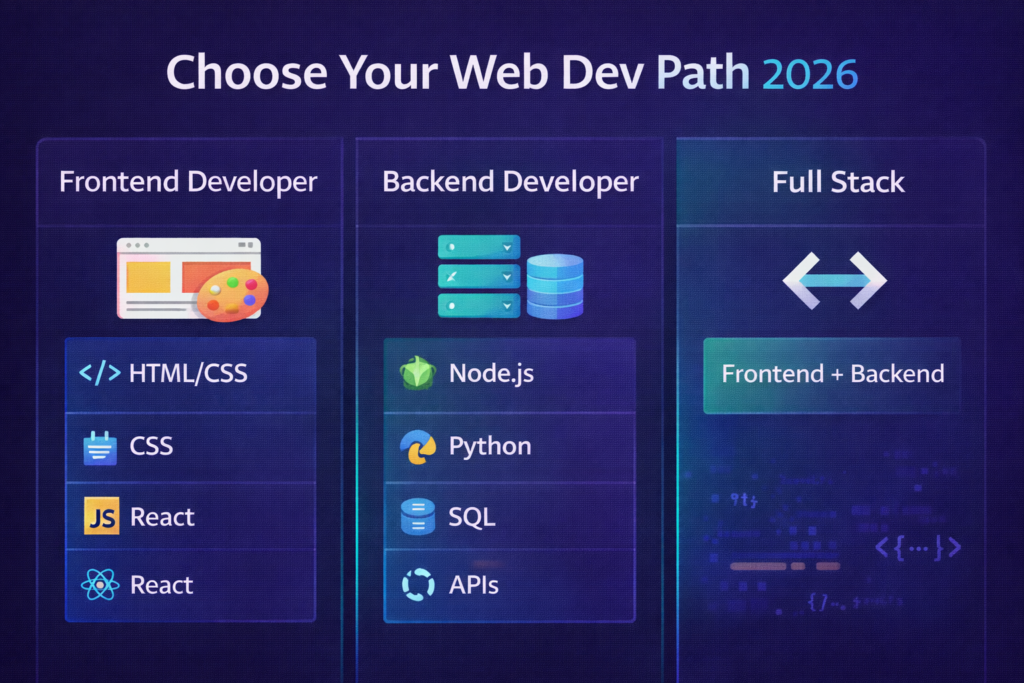
The first decision in any web developer roadmap 2026 is understanding that ‘web developer’ is an umbrella term that covers three distinct career paths. Choosing the right one for your personality, strengths, and goals will make everything else in your learning journey far clearer and more focused.
Frontend Developer: The Visual Architect
Frontend developers build everything a user sees and interacts with directly in their browser. Buttons, menus, animations, layouts, forms — all of it is the frontend developer’s domain. If you love design, enjoy seeing immediate visual results from your code, and want to work closely with user experience, the frontend path is a natural fit. In 2026, frontend developers who can build fast, accessible, and beautifully designed interfaces are among the most in-demand professionals in the tech industry.
Backend Developer: The Engine Builder
Backend developers work behind the scenes — building the servers, databases, APIs, and logic that power everything the frontend displays. If you enjoy problem-solving, data management, system architecture, and working with the ‘brain’ of an application rather than its face, backend development might be your calling. Backend roles often command higher salaries and are in exceptionally high demand in 2026, particularly in fintech, healthcare tech, and enterprise software.
📎Read Also: Best Website Development Agency in India
Full Stack Developer: The Complete Package
Full stack developers are comfortable working on both the frontend and backend — they can build an entire web application from scratch, end to end. Startups and small companies particularly love full stack developers because of their versatility. The full stack path takes longer to master, but it opens the widest range of job opportunities and freelance potential. Most experienced developers recommend starting with frontend before moving to full stack.
Web Developer Roadmap 2026: The Complete Frontend Learning Path
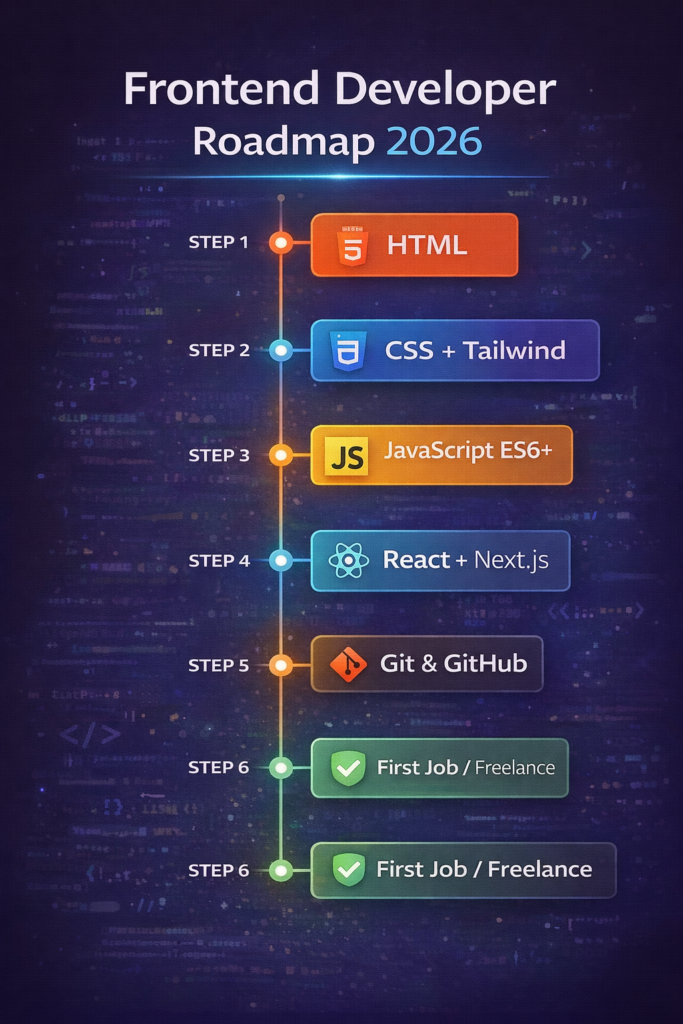
The frontend section of the web developer roadmap 2026 starts with three technologies that form the absolute foundation of everything on the modern web. There are no shortcuts here — these three must be learned in order, and they must be understood deeply before moving on to frameworks and tools.
Stage 1 — HTML: The Structure of the Web
HTML (HyperText Markup Language) is the skeleton of every webpage. It defines what content exists on a page — headings, paragraphs, images, links, forms, tables, and more. HTML is the single easiest technology on this entire roadmap to learn, and most dedicated learners can reach a solid working level within one to two weeks.
What to focus on in HTML:
- Semantic HTML5 elements (header, main, section, article, footer)
- Forms, input types, and form validation attributes
- Accessibility fundamentals — ARIA labels, alt text, keyboard navigation
- Meta tags and SEO-relevant HTML structure
📎Read Also: MDN Web Docs HTML guide
The best free resource for learning HTML is the MDN Web Docs HTML guide (https://developer.mozilla.org/en-US/docs/Web/HTML) — it is the gold standard reference for everything web-related and is used by beginner and senior developers alike every single day.
Stage 2 — CSS: Making the Web Beautiful
CSS (Cascading Style Sheets) is what transforms a plain HTML document into a visually designed webpage. Colours, fonts, layouts, spacing, animations, responsiveness — all of this is CSS. In 2026, CSS has grown enormously powerful with features like CSS Grid, Flexbox, custom properties (variables), and container queries making complex layouts achievable without a single line of JavaScript.
Key CSS concepts to master in 2026:
- CSS Flexbox — the most used layout tool for one-dimensional designs
- CSS Grid — the most powerful tool for two-dimensional layouts
- Responsive design with media queries and mobile-first methodology
- CSS custom properties (variables) for maintainable design systems
- Tailwind CSS — the utility-first CSS framework dominating frontend development in 2026
Stage 3 — JavaScript: Bringing the Web to Life
JavaScript is the programming language of the web — and arguably the most important skill in the entire web developer roadmap. It adds interactivity, logic, and dynamic behaviour to websites. Every button that responds to a click, every form that validates your input, every animation that plays on scroll — JavaScript is making that happen.
JavaScript fundamentals every developer must know:
- Variables, data types, operators, and control flow (if/else, loops, switch)
- Functions, scope, closures, and the ‘this’ keyword
- DOM manipulation — selecting, creating, modifying, and deleting HTML elements
- Asynchronous JavaScript — Promises, async/await, and the Fetch API
- ES6+ modern syntax — arrow functions, destructuring, spread operator, modules
Stage 4 — React: The Framework That Gets You Hired in 2026
Once you are comfortable with vanilla JavaScript, the next step for every frontend developer in 2026 is React. React is the most widely used JavaScript framework in the world, and it appears in more job listings than any other frontend technology by a significant margin. Built and maintained by Meta, React allows developers to build complex, interactive user interfaces using reusable components.
Core React concepts to learn:
- Components — functional components and the component hierarchy model
- JSX — JavaScript XML syntax that combines HTML and JavaScript seamlessly
- Hooks — useState, useEffect, useContext, and custom hooks
- State management — React Context and when to reach for Redux or Zustand
- Next.js — the React framework for production that adds routing, SSR, and performance optimisation
Web Developer Roadmap 2026: The Backend Learning Path Explained
The backend portion of the web developer roadmap 2026 is where things get deeper, more logical, and — for many developers — significantly more rewarding. The backend is the invisible layer that makes web applications actually work. If frontend is the face, backend is the brain and the nervous system.
Choose a Backend Programming Language
In 2026, the most in-demand backend languages for web development are Node.js (JavaScript on the server), Python, and PHP. Here is a quick breakdown to help you choose:
- Node.js (JavaScript) — Best choice if you already know JavaScript from the frontend. Allows you to use one language across the entire stack. Extremely popular for APIs, real-time applications, and startups.
- Python (Django / FastAPI) — Excellent for beginners due to its clean, readable syntax. Dominant in data science and AI-adjacent web applications. Django is a powerful full-featured framework; FastAPI is the modern choice for high-performance APIs.
- PHP (Laravel) — Still widely used in 2026 for content management systems, e-commerce platforms, and enterprise web applications. Laravel is an elegant, feature-rich PHP framework with a strong job market.
Databases: SQL and NoSQL Essentials for 2026
Every backend developer needs to understand how to store, retrieve, and manage data using databases. In 2026, you should be familiar with both types:
- SQL Databases (PostgreSQL, MySQL) — Structured, relational databases perfect for applications with complex data relationships. PostgreSQL is the clear frontrunner in 2026 for new projects.
- NoSQL Databases (MongoDB) — Document-based databases ideal for flexible data structures, rapid prototyping, and applications where the data model evolves frequently.
APIs: The Language Backends and Frontends Use to Talk
Building APIs (Application Programming Interfaces) is the core daily task of most backend developers. REST APIs remain the industry standard, while GraphQL has carved out a significant niche for data-heavy applications. Every backend developer in 2026 should understand how to design, build, test, and document RESTful APIs thoroughly.
Essential Tools Every Web Developer Must Know in 2026
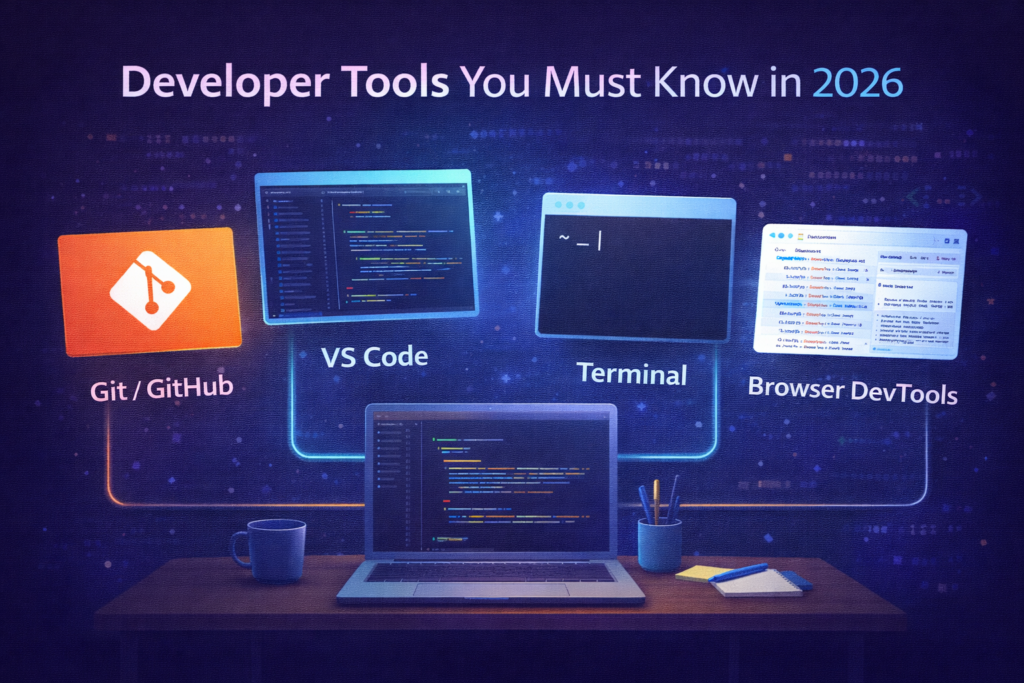
Beyond programming languages and frameworks, every professional web developer in 2026 relies on a core set of tools daily. These are not optional extras — they are the standard tools of the trade that every employer will expect you to be familiar with from day one.
Git and GitHub — Version Control Is Non-Negotiable
Git is the version control system used by virtually every professional development team on the planet. It tracks changes to your code, allows you to work collaboratively with other developers without breaking each other’s work, and lets you roll back to previous versions of your code when things go wrong. GitHub is the platform where most code is hosted and shared. Learning Git is not optional — it is a day-one requirement in every web development job.
VS Code — The Developer’s Best Friend
Visual Studio Code (VS Code) is the most widely used code editor in the world in 2026, and for excellent reason — it is fast, extensible, intelligent, and completely free. Learn keyboard shortcuts, install essential extensions like Prettier, ESLint, GitLens, and the Live Server extension, and customise it to your workflow. A developer who knows their tools deeply is significantly more productive than one who doesn’t.
Command Line / Terminal — Speaking the Language of Computers
Every web developer needs to be comfortable working in the terminal or command line. From running development servers to installing packages, pushing code to GitHub, and managing files — the terminal is where much of a developer’s real work happens. You do not need to become a Linux expert, but basic command line fluency is absolutely essential.
Browser DevTools — Debug Like a Professional
The browser developer tools (built into Chrome, Firefox, and Edge) are among the most powerful debugging tools a frontend developer has. Learn how to inspect and modify HTML/CSS in real time, monitor network requests, debug JavaScript using breakpoints, check performance metrics, and test your site’s responsive behaviour across different screen sizes.
New Skills Added to the Web Developer Roadmap in 2026: AI and Beyond
The web developer roadmap 2026 includes skills that simply did not exist or were not relevant just two or three years ago. The rise of AI tools, cloud platforms, and edge computing has changed what employers expect from new developers entering the field. Ignoring these new additions is no longer an option if you want to remain competitive.
AI-Assisted Development: The New Normal
In 2026, the most productive web developers are the ones who have learned to work effectively alongside AI coding tools. GitHub Copilot, Cursor, and similar AI pair-programming tools are now standard in professional development environments. Learning how to prompt these tools effectively, how to evaluate and refactor AI-generated code, and how to use AI to accelerate your learning process without becoming dependent on it — these are genuinely valuable skills that distinguish modern developers.
TypeScript: JavaScript’s More Professional Big Brother
TypeScript has moved from ‘nice to have’ to ‘expected on your resume’ in 2026. TypeScript adds optional static typing to JavaScript, catching errors before your code ever runs and making large codebases dramatically easier to maintain and understand. The majority of professional React and Node.js projects now use TypeScript by default, and employers strongly prefer candidates who are comfortable with it.
Web Performance and Core Web Vitals
Google’s Core Web Vitals — metrics measuring loading performance, interactivity, and visual stability — have become a genuine ranking factor in search results. Web developers in 2026 who understand performance optimisation techniques like lazy loading, code splitting, image optimisation, and caching strategies are significantly more valuable than those who can only write code that works without considering how fast it loads.
Building Your Portfolio: How to Get Hired as a Web Developer in 2026
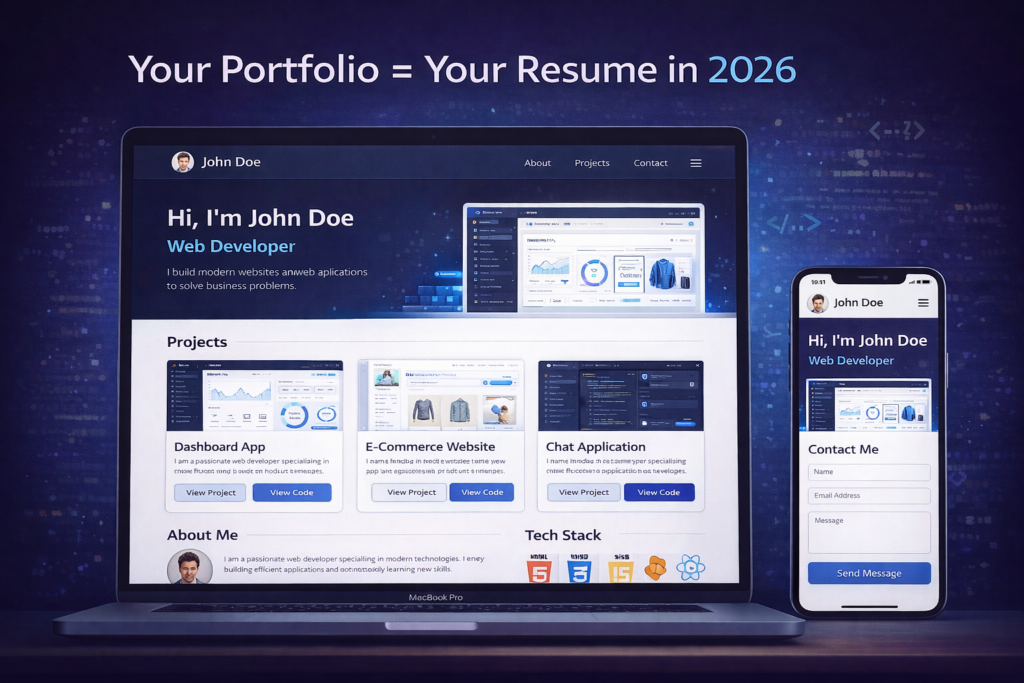
Here is the reality that the web developer roadmap 2026 does not always make clear enough: a certificate or a course completion badge will not get you hired. Your portfolio will. Employers and clients want to see real projects that demonstrate real skills. The good news is that you do not need dozens of projects — you need three to five genuinely impressive, well-built projects that show you can solve real problems with code.
What Makes a Great Portfolio Project in 2026
- It solves a real problem — build things that an actual human being would want to use, not just a demo app that exists only to show you can code.
- It is deployed and live — push your projects to Vercel, Netlify, or GitHub Pages so they are publicly accessible. A GitHub link to code is less impressive than a live, working application.
- It is fully responsive — your project must look and function correctly on mobile, tablet, and desktop screens.
- The code is clean and well-documented — employers will look at your code. Write it as if a senior developer will review it, because they will.
5 Portfolio Project Ideas That Impress Employers in 2026
- A full-stack e-commerce application with product listings, a shopping cart, user authentication, and a payment integration (Stripe)
- A real-time chat application using WebSockets (Socket.io) with user rooms and message history
- A weather dashboard that fetches live data from a public API and displays it in a clean, well-designed interface
- A personal portfolio website with smooth animations, a contact form, and a projects showcase section
- A task management or productivity app with user authentication, CRUD operations, and a clean, intuitive UI
Web Developer Salary and Job Market Outlook for 2026
Understanding the job market is a critical but often overlooked component of the web developer roadmap 2026. You are not just learning skills for their own sake — you are preparing for a career. And the 2026 web development job market, while competitive, remains strongly favourable for developers with the right skills and a solid portfolio.
Average Web Developer Salaries in 2026
- Junior Web Developer: $50,000 – $75,000 per year (USA average)
- Mid-Level Web Developer: $75,000 – $110,000 per year
- Senior Web Developer: $110,000 – $160,000+ per year
- Freelance Web Developer: $50 – $150+ per hour depending on niche and experience
Remote work remains the dominant employment model for web developers in 2026, with the majority of open positions offering either fully remote or hybrid arrangements. This opens the door for developers worldwide to access salaries that were previously only available in major tech hubs like San Francisco, New York, or London.
Realistic Timeline and Best Free Resources to Follow the Roadmap
One of the biggest sources of discouragement for new developers is having unrealistic expectations about how long learning takes. Let’s set honest, achievable expectations so you can plan your journey without burning out.
Realistic Learning Timeline for Web Development in 2026
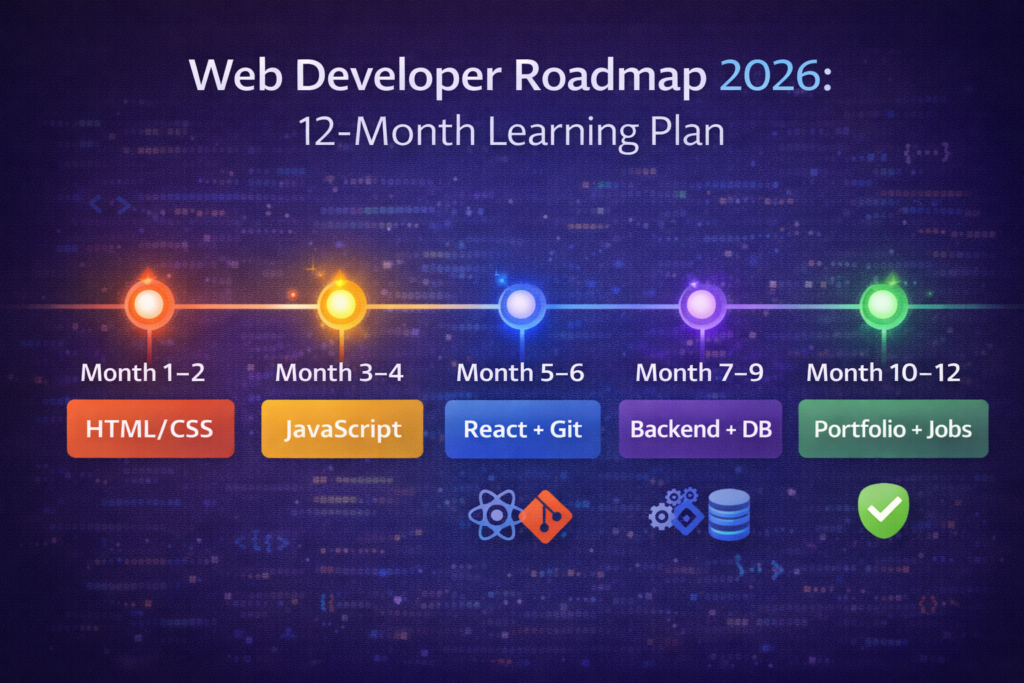
- Months 1–2: HTML, CSS, and basic JavaScript fundamentals. You should be able to build static, styled webpages from scratch.
- Months 3–4: Intermediate JavaScript — DOM manipulation, APIs, asynchronous code, ES6+ syntax. Build 2–3 JavaScript projects.
- Months 5–6: React fundamentals, Git, and deployment. Build your first React applications and deploy them live.
- Months 7–9: Backend development basics, databases, REST APIs. Start building full-stack applications.
- Months 10–12: Portfolio refinement, TypeScript, job applications, interview preparation. You are ready to apply for junior positions.
Best Free Learning Resources for Web Developers in 2026
- The Odin Project (theodinproject.com) — The most comprehensive free full-stack web development curriculum available anywhere
- freeCodeCamp (freecodecamp.org) — Excellent structured curriculum with certificates in Responsive Web Design, JavaScript, React, and more
- MDN Web Docs (developer.mozilla.org) — The definitive reference documentation for HTML, CSS, and JavaScript
- Roadmap.sh (roadmap.sh) — Beautifully designed, community-maintained visual roadmaps for every web development career path
- JavaScript.info (javascript.info) — Arguably the best free resource for learning JavaScript from beginner to advanced
Web Developer Roadmap 2026: Your Journey Starts Today
The web developer roadmap 2026 is clear, achievable, and genuinely rewarding for anyone willing to put in the consistent, focused effort it requires. Web development remains one of the most accessible, well-paying, and creatively satisfying careers available in the modern economy — and the barriers to entry have never been lower.
In this guide, we covered the three web development career paths and how to choose the right one for you, the complete frontend learning sequence from HTML through React and Next.js, the backend technologies and databases that power modern web applications, the essential tools every developer needs to master in 2026, the new skills that matter including TypeScript and AI-assisted development, how to build a portfolio that actually gets you hired, realistic salary expectations and job market insights, and a concrete 12-month timeline with the best free resources available.
The developers who succeed are not the most naturally talented ones. They are the ones who start, stay consistent even when it gets hard, build real things, and never stop learning. Every senior developer you admire was once exactly where you are right now — staring at a blank screen, wondering where to begin.
Open your code editor. Write your first line of HTML. Your journey begins now.
Frequently Asked Questions About the Web Developer Roadmap 2026
Q1: How long does it take to become a web developer in 2026?
With consistent daily practice of 2–4 hours, most dedicated beginners can reach a junior web developer level within 9 to 12 months. Studying full-time (6–8 hours per day) can compress this to 4–6 months. The key variables are consistency, the quality of your learning resources, and how actively you build real projects rather than just watching tutorials.
Q2: Do I need a computer science degree to become a web developer in 2026?
No — absolutely not. The majority of working web developers in 2026 are self-taught or attended coding bootcamps rather than pursuing a traditional four-year computer science degree. Employers care overwhelmingly about your portfolio, your problem-solving ability, and your communication skills. A degree can open certain doors in large corporations, but it is by no means required for a successful and well-paid web development career.
Q3: Should I learn JavaScript or Python first in 2026?
If your goal is web development, learn JavaScript first — every time. JavaScript is the only programming language that runs natively in web browsers, making it the unavoidable foundation of web development regardless of which path you choose. Python is excellent for data science, AI, and backend development, but JavaScript is uniquely essential for the web. Master JavaScript first, then add Python or any other language as a secondary skill.
Q4: Is React still the best framework to learn in 2026?
Yes, React remains the dominant frontend framework in 2026 by a significant margin in terms of job listings, community size, ecosystem maturity, and industry adoption. Vue.js and Svelte are excellent alternatives worth exploring after React, and Angular maintains strong enterprise adoption. However, if your goal is maximum employability with a single framework investment, React is still the clearest answer in 2026.
Q5: How important is mathematics for web development?
For the vast majority of web development work — building websites, web applications, APIs, and user interfaces — advanced mathematics is not required. Basic arithmetic, logical thinking, and the ability to understand algorithms at a conceptual level is entirely sufficient for a long and successful web development career. Mathematics becomes significantly more important if you pursue game development, graphics programming, machine learning, or highly specialised technical fields.
Q6: Can I learn web development for free in 2026?
Absolutely yes. The free resources available for learning web development in 2026 — The Odin Project, freeCodeCamp, MDN Web Docs, JavaScript.info, and Roadmap.sh — are genuinely world-class and have produced thousands of employed web developers. Paid courses and bootcamps can accelerate learning with structure and mentorship, but they are entirely optional. Many of the best developers working today learned exclusively from free resources.
Q7: What is the difference between a web developer and a web designer?
A web designer focuses on the visual and user experience aspects of a website — how it looks, feels, and flows for the user. They typically use tools like Figma, Adobe XD, or Photoshop to create visual mockups. A web developer takes those designs and builds the actual functional website using code. Some professionals do both — called UI developers or design engineers — but they are distinct disciplines with distinct skill sets and career paths.




2 thoughts on “Web Developer Roadmap 2026: Complete Beginner’s Guide to Landing Your First Dev Job”