
The Indian stock market in 2026 is navigating a fascinating period of tension between near-term global headwinds, FII outflows exceeding ₹60,000 crore, crude oil above $100 per barrel, Middle East geopolitical pressures, and a weakening rupee, and India’s enduring structural growth story as the world’s fastest-growing major economy.
With the Sensex trading around 74,532 and Nifty above 23,100, this comprehensive guide covers everything a reader needs to understand the market’s architecture (BSE, NSE, SEBI, Sensex, Nifty), the current performance drivers across IT, metals, banking, and energy sectors, a complete step-by-step guide to opening a demat account and making the first investment, proven strategies including SIP, value investing, and index investing, the real risks every investor must understand, and ten powerful principles that give beginners the strongest possible foundation for building long-term wealth in India’s dynamic and rewarding equity markets.
Table of Contents
Indian Stock Market in 2026: Why Now Is a Critical Time for Every Investor
The Indian stock market in 2026 stands at one of the most fascinating and challenging crossroads in its modern history. As of March 2026, the BSE Sensex trades around 74,532 points and the Nifty 50 holds above 23,100 navigating a complex web of global geopolitical tensions, crude oil volatility above $100 per barrel, significant foreign institutional investor (FII) outflows exceeding ₹60,000 crore in the March series, and yet stubbornly, impressively maintaining resilience driven by strong domestic institutional investor (DII) buying, robust IT sector performance, and India’s unwavering long-term growth story.
Accelerate Your Digital Growth with Osdire
Unlock premium digital tools, web optimization, and specialized infrastructure designed for modern businesses.
Explore Osdire Offers →Whether you are a first-time investor trying to understand what a demat account is, an experienced trader tracking FII positioning, or a long-term wealth builder looking for the next great opportunity this guide is written for you. We have deliberately avoided jargon where possible, explained every concept clearly where necessary, and grounded every insight in the current real-world conditions of the Indian market in March 2026.
India is no longer just another emerging market. It is the world’s fastest-growing major economy, home to the world’s largest population, and increasingly the preferred destination for global capital looking for long-term growth. Understanding the Indian stock market is no longer optional for anyone serious about building wealth in the 21st century. Let’s begin.
Indian Stock Market Structure: BSE, NSE, Sensex, and Nifty Explained
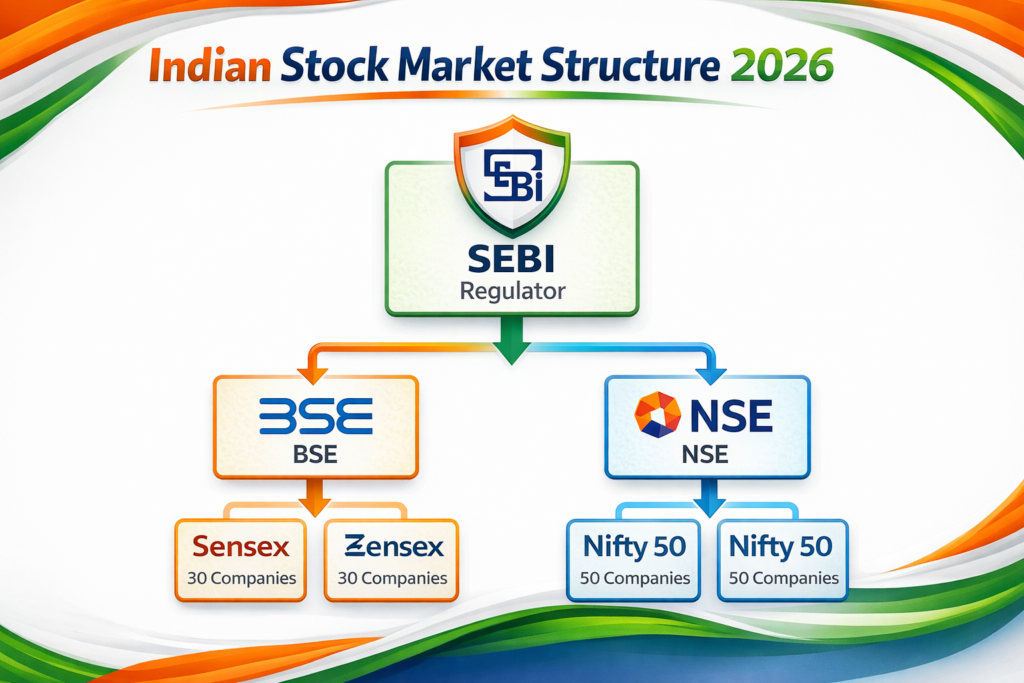
To truly understand the Indian stock market, you first need to understand its architecture, the exchanges, the indices, and the regulatory bodies that hold the entire system together.
BSE The Bombay Stock Exchange
Established in 1875, the Bombay Stock Exchange (BSE) is Asia’s oldest stock exchange and one of the largest in the world by number of listed companies. With over 5,000 companies listed on it, the BSE is the primary listing destination for Indian companies ranging from massive conglomerates to small-cap businesses. The BSE’s flagship index is the SENSEX, formally known as the S&P BSE Sensex a free-float market capitalisation-weighted index of 30 of the largest and most actively traded stocks on the exchange.
📎 Read Also: BSE India official website
NSE The National Stock Exchange
Founded in 1992 and operational since 1994, the National Stock Exchange (NSE) is India’s largest stock exchange by trading volume. The NSE revolutionised Indian capital markets by introducing screen-based electronic trading for the first time, replacing the old open-outcry system. Its benchmark index the Nifty 50, tracks the performance of the 50 largest and most liquid companies listed on the NSE and is the most widely followed barometer of Indian equity market performance globally.
📎 Read More: Web Developer Roadmap 2026
SEBI: The Regulator That Protects Every Investor
The Securities and Exchange Board of India (SEBI) is the statutory regulator of the Indian stock market, established in 1992. SEBI’s mandate is to protect the interests of investors, promote the development of the securities market, and regulate market intermediaries. Every broker, mutual fund, portfolio manager, and market intermediary operating in India must be registered with and regulated by SEBI. For retail investors, SEBI’s oversight is one of the most important safeguards available, ensuring transparency, fair dealing, and accountability across the market.
Indian Stock Market Today: Where Do Sensex and Nifty Stand in March 2026?
The Indian stock market in March 2026 is a story of two forces locked in a constant tug-of-war. On one side: domestic strength, India’s long-term growth story, strong DII buying, and resilient IT and metal sectors. On the other: FII outflows, Middle East geopolitical tensions driving crude oil above $100 per barrel, a weakening rupee hitting record lows, and global trade uncertainty.
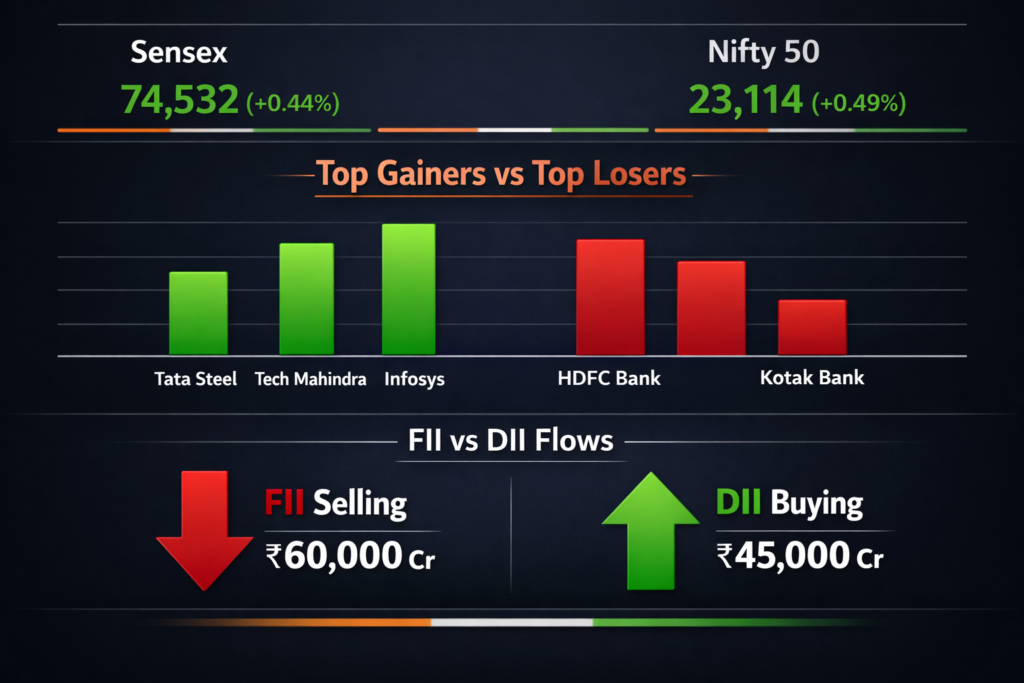
Current Market Snapshot March 20, 2026
- BSE Sensex: Closed at 74,532.96 — up 325.72 points (+0.44%) on March 20, 2026
- Nifty 50: Closed at 23,114.50 — up 112.35 points (+0.49%), supported by IT and metal stocks
- Top Gainers: Tata Steel (+3.23%), Tech Mahindra (+3.01%), Infosys (+2.78%), Trent (+2.41%), Reliance Industries (+2.11%)
- Top Losers: HDFC Bank (-2.41%), BEL (-1.10%), Kotak Mahindra Bank (-0.57%), ICICI Bank (-0.42%)
- Market Breadth: Positive — 21 Sensex stocks advanced vs 9 declined
Key Factors Driving the Market in 2026
FII vs DII Battle: The Invisible War, Moving Markets
One of the most critical dynamics in the Indian stock market right now is the fierce battle between Foreign Institutional Investors (FIIs) and Domestic Institutional Investors (DIIs). FIIs have sold over ₹60,000 crore worth of Indian equities in the March 2026 series, driven by geopolitical risk, crude oil surges, and global risk aversion. However, DIIs, primarily Indian mutual funds funded by retail SIP flows, have consistently absorbed this selling, preventing sharper declines. This DII strength is a genuine sign of the maturation of India’s domestic investment ecosystem.
Crude Oil Above $100: The Wild Card
Brent crude crossed $100 per barrel in March 2026, surging as high as $119 amid Middle East energy infrastructure attacks before easing back to around $107 after diplomatic interventions. For India, which imports approximately 85% of its crude oil requirements, elevated oil prices are a direct economic headwind. They widen the current account deficit, put pressure on the rupee, fuel inflation, increase input costs for manufacturing and FMCG companies, and generally dampen market sentiment. The crude oil situation remains the single most important global variable for Indian equity markets in 2026.
IT Sector: India’s Market Leader in 2026
IT stocks have been the clear market leaders in recent sessions, with Nifty IT rising over 1.5% as investors bet on continued digital transformation and outsourcing demand from global clients in the US and Europe. Infosys, TCS, HCL Technologies, Tech Mahindra, and Wipro are all showing strong momentum. Artificial intelligence-led project wins, cost optimisation mandates from global corporations, and robust earnings expectations have kept IT sentiment firmly bullish even as other sectors face pressure.
How to Invest in the Indian Stock Market: Complete Step-by-Step Guide for Beginners
Investing in the Indian stock market has never been more accessible than it is in 2026. The combination of digital demat accounts, zero-commission brokers, UPI-based payments, and fractional investing has completely removed the barriers that once kept ordinary Indians out of the equity markets. Here is exactly how to get started.
Step 1: Open a Demat and Trading Account
A demat (dematerialised) account is the digital vault where your shares are stored electronically. A trading account is what you use to place buy and sell orders on the exchange. In India, you need both and most modern brokers offer them together in a single integrated platform. The entire account opening process is now 100% digital, taking as little as 15–30 minutes with e-KYC using your Aadhaar card, PAN card, bank account details, and a smartphone camera for the selfie verification.
The most popular discount brokers in India in 2026 are Zerodha, Upstox, Angel One, Groww, and 5paisa. Full-service brokers like ICICI Direct, HDFC Securities, and Motilal Oswal offer additional research and advisory services but typically charge higher brokerage fees.
📎Read More: Zerodha – India’s largest stockbroker
Step 2: Complete Your KYC and Fund Your Account
Once your demat and trading account is open and verified, link it to your bank account and transfer funds using NEFT, RTGS, or UPI. These funds sit in a client account maintained by your broker and are used to pay for your share purchases. Withdrawals back to your bank account typically process within one working day.
Step 3: Research, Select, and Buy Your First Stock
Before buying any stock, invest time in research. Look at the company’s fundamentals, revenue growth, profit margins, debt levels, return on equity, and the quality of management. Use financial platforms like Moneycontrol (moneycontrol.com), Screener. In, or Tickertape to access company financials, analyst reports, and historical data. Start with large-cap, well-established companies that you understand before venturing into mid-caps or small-caps.
Step 4: Understand Order Types
- Market Order — Buy or sell immediately at the current market price. Fast execution but no price control.
- Limit Order — Set the exact price at which you want to buy or sell. The order executes only when the market reaches your specified price.
- Stop-Loss Order — Automatically sells your stock if it falls below a specified price, limiting your downside loss.
Top Performing Sectors in the Indian Stock Market in 2026
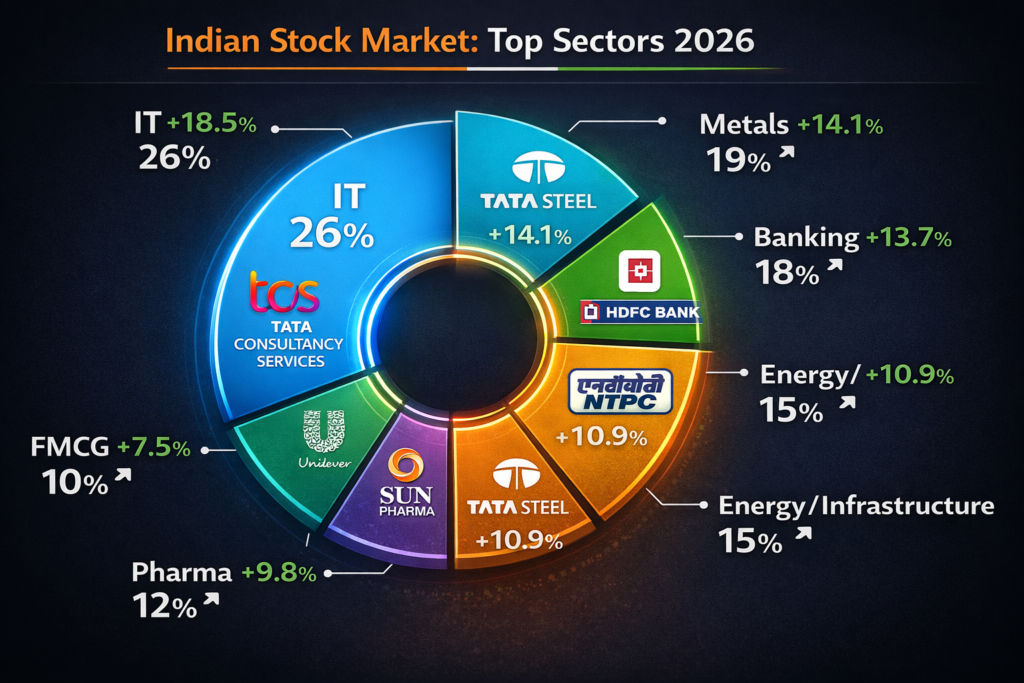
Sector selection is one of the most powerful levers available to investors in the Indian stock market. In 2026, not all sectors are created equal; some are thriving, some are under pressure, and some represent the most exciting long-term structural growth opportunities on the planet. Here is the current sector landscape.
IT and Technology: The Market Leader
India’s IT sector continues to be the backbone of the stock market and one of the primary reasons global investors remain interested in Indian equities. Companies like TCS, Infosys, HCL Technologies, Wipro, and Tech Mahindra are benefiting from global digital transformation, AI-driven project wins, and cost optimisation mandates from corporations worldwide. Nifty IT has been the strongest performing index in recent sessions and carries the most compelling combination of earnings visibility and global demand in 2026.
Metals and Mining Benefiting from Supply Disruptions
Metals have emerged as one of the top-performing sectors in March 2026, with Tata Steel leading Sensex gains at +3.23% and JSW Steel rising 3.28%. Supply disruptions from Middle East geopolitical tensions, strong demand from India’s infrastructure push, the global EV transition, and rising non-ferrous metal prices have all combined to create a favourable environment for Indian metals producers. ICICI Direct’s research suggests Metals and Auto could lead the market recovery in the next phase.
Banking and Financial Services Resilient but Under Pressure
Banking stocks have faced headwinds in March 2026, with HDFC Bank extending losses following the sudden resignation of part-time chairman Atanu Chakraborty, a significant corporate governance event that triggered a 2.4% single-session decline. Despite this, the broader banking sector remains fundamentally strong, with improving asset quality, healthy credit growth, and strong balance sheets across major private sector lenders. SBI has shown relative outperformance, rising 0.90% even on weak sessions.
Energy and Infrastructure India’s Long-Term Structural Play
India’s massive infrastructure push, roads, railways, renewable energy, ports, and smart cities, is creating generational investment opportunities in the energy and infrastructure space. NTPC, Power Grid, and Bharat Petroleum have all shown resilience in recent sessions. Renewable energy companies, in particular, represent one of the most compelling long-term structural growth stories in the entire Indian stock market universe.
Proven Investment Strategies for the Indian Stock Market in 2026
Succeeding in the Indian stock market requires more than just picking the right stocks; it requires a clear, disciplined investment strategy that matches your financial goals, risk tolerance, and investment horizon. Here are the approaches that work best for different types of investors in 2026.
Systematic Investment Plan (SIP): The Beginner’s Best Friend
For most retail investors, especially beginners, the SIP (Systematic Investment Plan) in equity mutual funds is the single most recommended starting point. A SIP allows you to invest a fixed amount (as low as ₹500 per month) in a mutual fund at regular intervals, automatically purchasing more units when prices are low and fewer when prices are high. This process, called rupee cost averaging, naturally smooths out the volatility of the stock market over time and removes the dangerous temptation to time the market.
Value Investing Buy Great Businesses at Fair Prices
Value investing, popularised by Warren Buffett and Benjamin Graham, is the practice of identifying fundamentally strong businesses that are temporarily undervalued by the market and buying them at a price below their intrinsic value. In the Indian context, the current market volatility driven by geopolitical tensions and FII outflows has created genuine value opportunities in banking, auto, and realty stocks that have corrected 10–15% from their peaks without any fundamental deterioration in their business quality.
Growth Investing Ride India’s Structural Tailwinds
India’s structural growth story, a young population, rising middle class, rapid digitisation, infrastructure boom, and manufacturing renaissance under PLI schemes, create compelling growth investing opportunities across multiple sectors. Growth investors focus on companies with above-average revenue and earnings growth rates, even if they currently trade at premium valuations. IT services, consumer discretionary, clean energy, and financial technology companies represent the richest hunting ground for growth investors in the Indian market in 2026.
Index Investing Simple, Low-Cost, and Surprisingly Effective
Investing in index funds or ETFs (Exchange Traded Funds) that track the Nifty 50 or Sensex is a surprisingly powerful strategy that outperforms the majority of actively managed funds over long time horizons. Index funds have ultra-low expense ratios, zero fund manager risk, and automatic rebalancing. For investors who do not want to spend time analysing individual stocks, a simple monthly SIP into a Nifty 50 index fund is a fully defensible long-term wealth creation strategy.
Risks Every Investor Must Understand Before Entering the Indian Stock Market
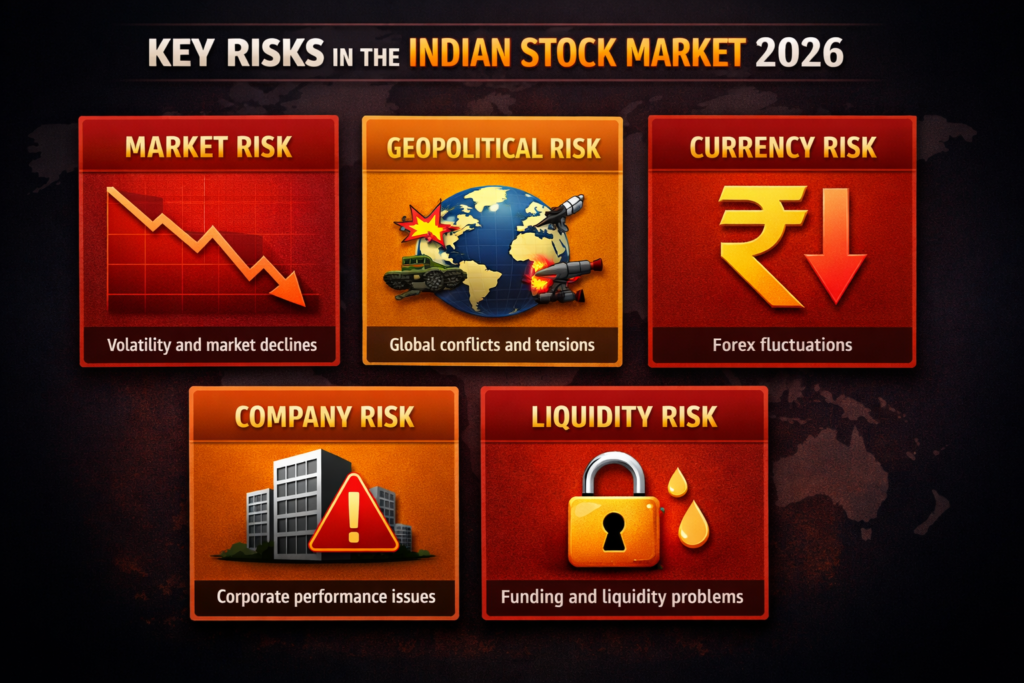
No honest guide to the Indian stock market would be complete without a frank discussion of the real risks involved. Markets do not go up in a straight line, and 2026 has provided multiple reminders of this reality. Understanding risk is not pessimism it is the foundation of intelligent investing.
- Market Risk — The possibility that the overall market declines, pulling down even fundamentally strong stocks. As seen in January 2026, when reports of potential 500% US tariffs on Indian goods triggered a 780-point Sensex crash, even solid businesses are not immune to macro-driven market declines.
- Geopolitical Risk — Middle East tensions, India-US trade relations, China border dynamics, and oil price shocks all have demonstrated direct impacts on Indian equity markets in 2026.
- Currency Risk — A weakening Indian rupee increases import costs, widens the fiscal deficit, and can trigger broader market selloffs as seen with the rupee hitting record lows in March 2026.
- Company-Specific Risk — Individual companies can face governance issues, earnings disappointments, regulatory challenges, or management changes that trigger sharp price declines — as demonstrated by HDFC Bank’s sharp fall following the resignation of its part-time chairman.
- Liquidity Risk — Smaller mid-cap and small-cap stocks can be difficult to sell quickly at fair prices during periods of market stress, potentially trapping investors at unfavourable prices.
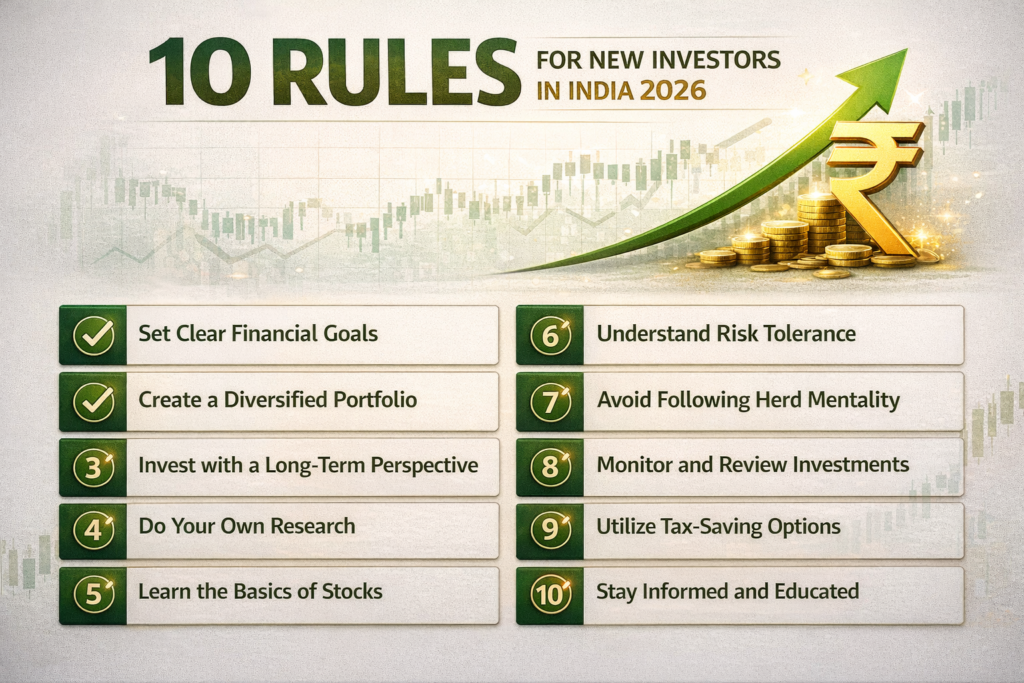
10 Powerful Tips for Beginners Entering the Indian Stock Market in 2026
Starting your journey in the Indian stock market can feel overwhelming. These ten principles, drawn from decades of market wisdom and adapted to the specific conditions of 2026, will give you the strongest possible foundation.
- Start Small, Learn First — Invest only money you can afford to lose while learning. Begin with ₹5,000–₹10,000 and treat early losses as tuition fees.
- Never Invest Money You Need Short-Term — Stock market investments should have a minimum 3–5 year horizon. Never invest money needed for rent, school fees, or emergencies.
- Diversify Across Sectors — Spread your investments across multiple sectors to reduce the impact of any single sector downturn.
- Always Use Stop-Loss Orders — Define your maximum acceptable loss before entering any trade. Discipline in cutting losses is the single most important trading skill.
- Invest in Businesses You Understand — Only invest in companies whose business model, competitive advantage, and industry you genuinely understand.
- Ignore Short-Term Market Noise — Daily market movements are mostly noise. Focus on the long-term fundamentals of the businesses you own.
- Never Follow Tips Blindly — WhatsApp stock tips, social media ‘multibaggers,’ and anonymous tip channels have destroyed more retail wealth than any market crash.
- Keep Learning — Read annual reports, follow SEBI guidelines, and study market history. The investor who never stops learning will always outperform the one who stops.
- Track Your Portfolio, Not the Market — Monitor the performance of your specific holdings and the fundamentals of the companies you own, not just the Sensex number.
- Be Patient — Wealth creation in the stock market is not a sprint — it is a marathon measured in years and decades, not days and weeks.
Conclusion: The Indian Stock Market in 2026: Challenge, Opportunity, and Long-Term Promise
The Indian stock market in 2026 is not for the faint-hearted, but it has never been more full of opportunity for the disciplined, patient, and informed investor. Yes, there are genuine near-term headwinds: FII selling, crude oil volatility, rupee weakness, and geopolitical uncertainty. But these are cyclical pressures layered on top of a structural growth story that remains fundamentally intact and enormously compelling.
India is the world’s fastest-growing major economy. Its young demographic dividend, rising disposable incomes, digital infrastructure revolution, manufacturing renaissance, and deepening capital markets all point in the same long-term direction: upward. The Sensex has delivered compounded returns of approximately 14–15% per year over the past three decades. Patient investors who stayed through every crisis, the 2008 global financial collapse, the COVID crash of 2020, the geopolitical disruptions of 2022 and 2026, have been richly rewarded.
The best time to start investing in the Indian stock market was ten years ago. The second-best time is today. Open your demat account, start your SIP, invest in businesses you understand, stay diversified, stay patient — and let the power of compounding and India’s growth story do the rest.
Frequently Asked Questions About the Indian Stock Market
Q1: What is the minimum amount needed to invest in the Indian stock market?
There is no legally mandated minimum investment in the Indian stock market. You can buy a single share of any company at its current market price, which could be as low as ₹10 for a small-cap stock or as high as several thousand rupees for premium stocks like MRF or Honeywell. For mutual fund SIPs, many platforms allow you to start with as little as ₹100 per month. Practically speaking, most beginners find ₹5,000–₹10,000 a comfortable starting point for direct stock investments.
Q2: Is the Indian stock market safe for beginners?
The Indian stock market is regulated by SEBI, which provides strong investor protections. However, all stock market investments carry risk, including the risk of losing capital. For beginners, the safest entry points are: (a) diversified equity mutual funds through monthly SIPs, (b) Nifty 50 or Sensex index funds, and (c) large-cap, established companies with strong track records. Avoiding speculative penny stocks, F&O (futures and options) trading, and leveraged positions is essential for new investors.
Q3: What is the difference between Sensex and Nifty 50?
The Sensex (S&P BSE Sensex) is a stock index comprising the 30 largest and most actively traded companies on the Bombay Stock Exchange (BSE). The Nifty 50 is the flagship index of the National Stock Exchange (NSE), tracking the 50 largest companies by free-float market capitalisation listed on the NSE. Both indices are considered benchmark indicators of overall Indian stock market performance. The Nifty 50 is broader and more widely used by institutional investors, while the Sensex has greater historical recognition and media coverage.
Q4: Can foreign nationals invest in the Indian stock market?
Yes. Foreign nationals and entities can invest in the Indian stock market through two primary routes: (a) as Foreign Institutional Investors (FIIs/FPIs), registered institutional investors like foreign mutual funds, insurance companies, and pension funds, or (b) through the Foreign Direct Investment (FDI) route. Non-Resident Indians (NRIs) can invest through NRE/NRO demat accounts under the Portfolio Investment Scheme (PIS) guidelines established by RBI and SEBI.
Q5: What are the trading hours of the Indian stock market?
The Indian stock market (both BSE and NSE) operates from Monday to Friday, excluding public holidays. Regular trading hours are from 9:15 AM to 3:30 PM IST. There is also a pre-market session from 9:00 AM to 9:15 AM for order collection and price discovery. Post-market hours run from 3:40 PM to 4:00 PM. Commodity markets and currency derivatives have extended trading hours that run into the evening.
Q6: What taxes apply to stock market gains in India?
Stock market gains in India are subject to capital gains tax. Short-Term Capital Gains (STCG), from equity shares or equity mutual funds held for less than 12 months, are taxed at 20% (revised from 15% in 2024). Long-Term Capital Gains (LTCG), from equity investments held for more than 12 months, are taxed at 12.5% on gains exceeding ₹1.25 lakh per financial year (revised from ₹1 lakh and 10% in the 2024 Budget). Dividends received from stocks are taxed as regular income at your applicable income tax slab rate.
Q7: Will the Indian stock market crash in 2026?
Nobody, not the most sophisticated analyst, not the most experienced fund manager, not any artificial intelligence model, can reliably predict a stock market crash. What we can say with confidence is that short-term corrections are a normal and healthy part of any bull market, and the Indian market has already experienced significant pressure in 2026 through FII selling, crude oil shocks, and geopolitical tensions. ICICI Direct’s research suggests the bulk of the near-term decline may already be priced in, with a sharp recovery into the April series appearing probable. Long-term investors are strongly advised not to make drastic decisions based on short-term market fear.